Inshore vs. Nearshore vs. Offshore Fishing, Explained
The difference is how far from shore you fish, and nearly everything else follows from that. Inshore trips stay in protected water: bays, marshes, flats, sounds and river mouths, in a small boat that rarely loses sight of land. Nearshore trips head into open ocean within a few miles of the beach to fish reefs, wrecks and inlets. Offshore trips run out to deep blue water, often 20 miles or more, for mahi mahi, tuna, wahoo and billfish.
That distance decides the boat, the fish, how rough the ride is, how much of the day goes to running, and the price. On our listings, guides who target speckled trout list a median full day of about $950. For guides who target wahoo, it's about $1,600.
The three at a glance
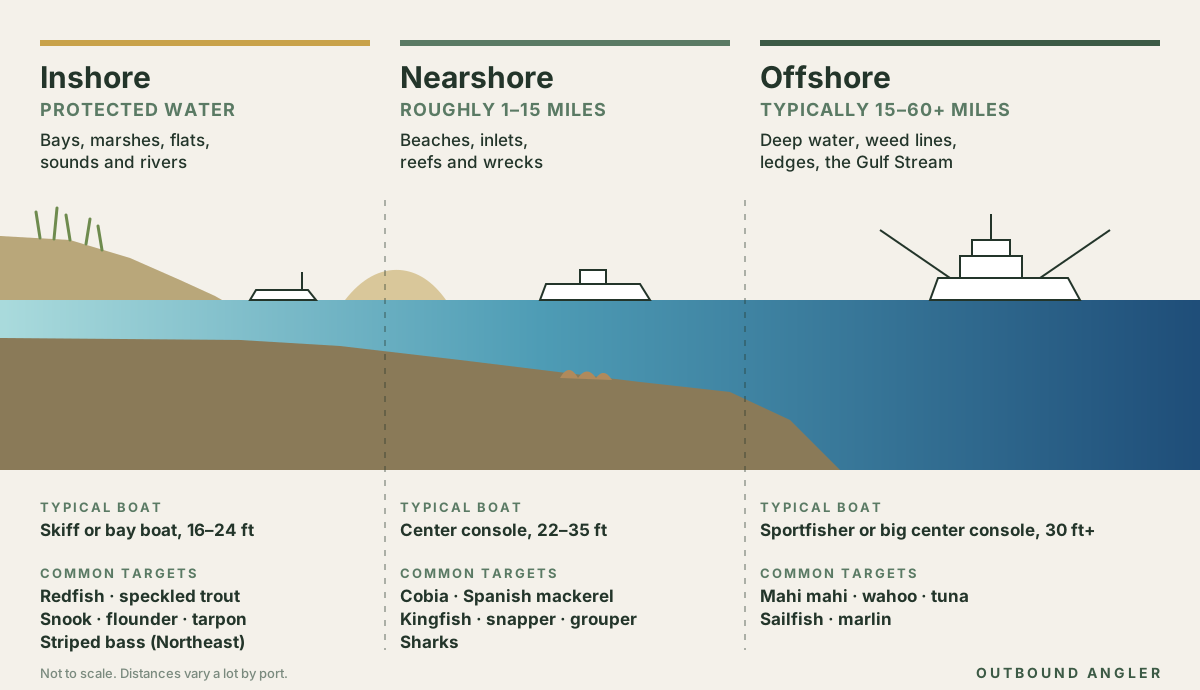
Where you fish. Inshore: Bays, marshes, flats, sounds, rivers. Nearshore: Beaches, inlets, nearshore reefs and wrecks. Offshore: Deep water, weed lines, ledges, the Gulf Stream.
Typical distance. Inshore: Protected water near the dock. Nearshore: Roughly 1–15 miles off the beach. Offshore: Typically 15–60+ miles out.
Boat. Inshore: Flats skiff or bay boat, 16–24 ft. Nearshore: Center console or small sportfisher, 22–35 ft. Offshore: Sportfisher or big center console, 30 ft+.
Anglers. Inshore: Usually 1–3. Nearshore: 2–6. Offshore: 4–6.
Running time. Inshore: Minutes. Nearshore: 10–45 minutes. Offshore: Up to 2 hours each way.
The ride. Inshore: Smoothest. Nearshore: Depends on the day. Offshore: Roughest.
Common targets. Inshore: Redfish, speckled trout, snook, flounder, tarpon, striped bass. Nearshore: Cobia, Spanish mackerel, kingfish, snapper, grouper, sharks. Offshore: Mahi mahi, wahoo, tuna, sailfish, marlin.
None of these lines are official. One captain might call a 12-mile reef trip offshore and another might call it nearshore. When you book, ask how long the run is in minutes rather than going by the trip name.
The legal line is a separate thing. For most of the US coast, state waters run 3 nautical miles out and federal rules apply beyond that. In parts of the Gulf the line sits farther out. Either way, seasons and limits for the same fish can change with distance. Your captain tracks all of this. It's just why "can we keep one?" sometimes depends on where the fish was caught.
Inshore: the easiest day on the water
Inshore fishing starts soon after you leave the dock. Expect light tackle, shallow water, and often casting at fish you can see: tailing redfish in a marsh, or tarpon rolling in a channel. The guide may pole the skiff or ease it along on a trolling motor, and the fishing is as much about finding the fish as hooking them.
The usual targets are redfish (red drum) and speckled trout (spotted seatrout) from the Carolinas around to Texas, bonefish, permit and tarpon on the Florida Keys flats, and striped bass in the bays and rivers of the Northeast.
Who it suits: first-timers, families with young kids, anyone worried about seasickness, fly anglers, and anyone booking a half day. Protected water is much calmer than the ocean, and you lose almost none of the day to running.
The trade-offs: fewer anglers per boat, little shade, and on most skiffs, no bathroom. Wind is the main weather problem inshore. A skiff can fish on days that keep offshore boats at the dock, but strong wind muddies shallow water and makes sight fishing hard.
Nearshore: the middle ground
Nearshore trips are in open ocean, but close enough that the boat is fishing within half an hour or so. That's where you find cobia cruising the beaches, Spanish mackerel and kingfish (king mackerel) busting bait, and reef and wreck fish like snapper, grouper, black sea bass and amberjack. Sharks are common nearshore too, and in some places so are tarpon along the beaches in summer.
Who it suits: groups that want variety and some fish to take home, and anglers who want bigger fish than inshore without paying for a long run. Bottom fishing over a reef is about as easy as fishing gets: drop the bait down, wait for a bite, reel up. That makes it a good choice for kids who have outgrown the skiff.
The trade-offs: this is the ocean, and on a day with a decent swell the boat rocks at anchor. Nearshore trips also run into more seasons and size limits than inshore trips, since many reef fish are tightly regulated.
Offshore: the big-game day
Offshore is a different kind of day. In many ports the boat runs for an hour or two to reach blue water, and the mate sets out a trolling spread of lures and rigged baits. Then you wait, sometimes a long time, until a rod goes off and everyone is busy at once. The targets are open-water fish: mahi mahi (dolphinfish), wahoo, yellowfin and blackfin tuna, sailfish and marlin. Some boats also deep-drop on the bottom for tilefish and grouper.
The run depends a lot on where you leave from. In the Keys, deep water starts just past the reef. Off the Outer Banks, the Gulf Stream swings closer to shore than almost anywhere else north of Florida, at times within about 12 miles of Cape Hatteras. From many other ports it's 40 miles or more before anyone puts out a line.
Who it suits: groups of four to six splitting the cost, anglers after a bucket-list fish, and anyone who doesn't mind a long, early day. Offshore boats are bigger and usually have a cabin, shade and a head. Most carry a mate, so budget a tip for the mate too.
The trade-offs: cost, the ride, and the weather. Offshore trips get canceled for wind and seas far more often than inshore trips. And some days are mostly riding, even with a good crew and a good plan.
What each costs on our listings
These are median listed prices for a full day (7–10 hours) on the whole boat, grouped by the species each guide says it targets:
Speckled trout (usually inshore): $950 median full day, 84 guides
Redfish (usually inshore): $975 median full day, 99 guides
Spanish mackerel (usually nearshore): $1,275 median full day, 43 guides
Mahi mahi (usually offshore): $1,500 median full day, 95 guides
Wahoo (usually offshore): $1,600 median full day, 73 guides
Marlin (usually offshore): $1,700 median full day, 56 guides
Across every listing, the median full day is $900 and the average is about $1,064.
Two caveats. First, the grouping is by guide, not by trip. Plenty of offshore boats also run inshore or nearshore trips, which pulls the numbers closer together than they really are. In the same port, a sound trip and a Gulf Stream trip are usually further apart in price than this list shows. Second, half days barely differ (a $600 median for inshore guides against $750 for mahi guides), mostly because a half day rarely gets anywhere near blue water.
Divide by the number of people aboard and the order can flip. A $1,600 offshore day split six ways is about $267 each. A $950 inshore day split two ways is $475 each. For more on what pushes a rate up and what's included, see how much a fishing charter costs.
Which one to book
First trip, or young kids along: inshore, half day.
Anyone prone to seasickness: inshore. Calm water helps more than anything else.
You want to fly fish or sight-cast: inshore flats.
You want variety and fish for dinner: nearshore.
Four to six people splitting the bill: nearshore or offshore. That's where per-person math works best.
You want a sailfish, a tuna or a big mahi: offshore, full day.
You want offshore but only have half a day: pick a port where deep water is close, like the Florida Keys, and ask the captain whether a half day can get you there.
Ask these before you book, whichever you pick
How long is the run from the dock to where we'll fish?
If it's too rough to go out, what's plan B? Many offshore captains will offer a nearshore or inshore trip instead of canceling.
Is there a bathroom on board?
How many anglers does the rate cover?
What's realistic to catch this time of year?
Captains who answer these in specifics, in minutes and in fish, are usually the ones worth booking. There are more questions like these in how to choose a fishing guide.
Want all three within reach of one place? The Outer Banks has sound, beach and Gulf Stream trips running out of the same few towns, with 53 guides listed.
Or start from the fish: redfish inshore, mahi mahi offshore, or search all 519 guides by region, species and water.